Maria and Karoline from Rosthaug High School.
Published May 12, 2017
Gratitude—do you know what it is?
“Gratitude will never mean the same thing to me again,” writes Maria Grønland Andresen after visiting The Gambia.
You think you know what gratitude is, and you also think you’re very grateful yourself. Grateful to have a place to live, a bed to sleep in, food to eat. Grateful for having a car and access to free education. At least you try to convince yourself that you are, because every now and then a hint of doubt creeps in. Of course, I’m talking about those afternoons when you dream of buying a third car, or when you and your fiancé discuss the possibility of buying a cabin by the ocean as well, in addition to the one you already have in the mountains. Of course, it’s okay to dream, but there are still times when you have to snap yourself back to reality and say out loud that you’re content with what you have. Grateful to be alive.
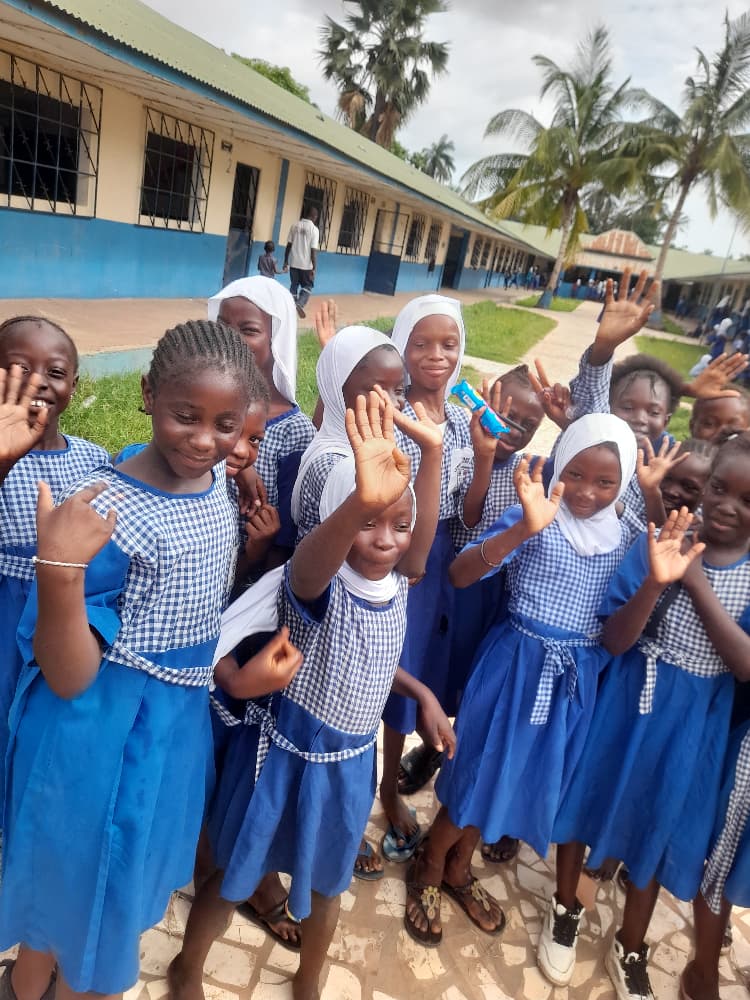
I’ve always thought of myself as a grateful person, but after my stay in The Gambia, I’ve realized that I should be much more grateful, because we’ve seen and experienced gratitude in a whole new dimension. One day we visited the Butterfly Friends school in Brikama, and it was the most incredible experience of my entire life. We’d been told beforehand that this school visit would make an impression, but I was in no way prepared for what awaited us, and it literally took my breath away. The entire school was standing in the schoolyard waiting for us; or to be more precise, they were standing in the schoolyard, on the stairs, and on the plateau above the schoolyard—that’s how many of them there were! The moment the minibus stopped outside the school gate, all the students began singing, jumping, clapping, and dancing wildly in true African spirit. We stood in the middle of the circle for 20 minutes watching their performance, all the while letting the gratitude sink in. The whole situation moved me deeply, and every one of us stood there with tears in our eyes. Gratitude will never mean the same thing to me again.
We sat on the flatbed of a truck as we drove to the slave island, Kunta Kinte. We drove along a bumpy dirt road, and every time we entered a neighborhood, children came running from all directions. They ran as fast as they could after the car, shouting to ask if we had any food or candy to give them. When you see the little legs of a three-year-old boy moving like drumsticks as he runs after the car, you realize that he really wants food. On the street, we walked past many people every day without giving them anything, and I promise you break a little more inside each time. Eventually, I bought some herbs from a little boy, which led to him and his brothers hugging me and telling me what a good person I was. How can I be a good person when I’ve walked past 20 of them without buying anything? I feel like it’s the same as choosing who gets dinner and who doesn’t.
In Norway, we say that education is important, and of course it is. But in The Gambia, education is even more important. If you fall through the cracks in Norway, we have a welfare system that can give us a nudge and help us find our way back to our place in society. If you have no education in The Gambia, your chances of getting a job are minimal. When we were at the beach, I asked some of the children if they liked going to school. They looked at me strangely and said they loved it. And of course they do—it was a silly question for me to ask. In Norway, we’re used to asking children if they like going to school, and we get a variety of answers. But in The Gambia, going to school is a distant dream for many, and those lucky enough to attend school are painfully aware that this is an opportunity that can change their lives. Of course they love it.
I’m not saying that Norwegians aren’t grateful, because I know that we all realize how good we have it and appreciate it. We aren’t Gambians. We don’t stand in the middle of the street singing with joy—that isn’t part of our culture, and that’s okay. What we can do, however, is set aside a minute every now and then to appreciate the things, the values, and the systems we’re so fortunate to have. Turning on the tap for water or eating a slice of bread isn’t a given everywhere in the world. Even if you’re good at pausing in your daily life to reflect every now and then, it doesn’t hurt to do it one more time. I didn’t do that before, but I know I’ll do it from now on. Because food isn’t a given. Clean water isn’t a given. Education and schooling aren’t a given. Life isn’t a given.